
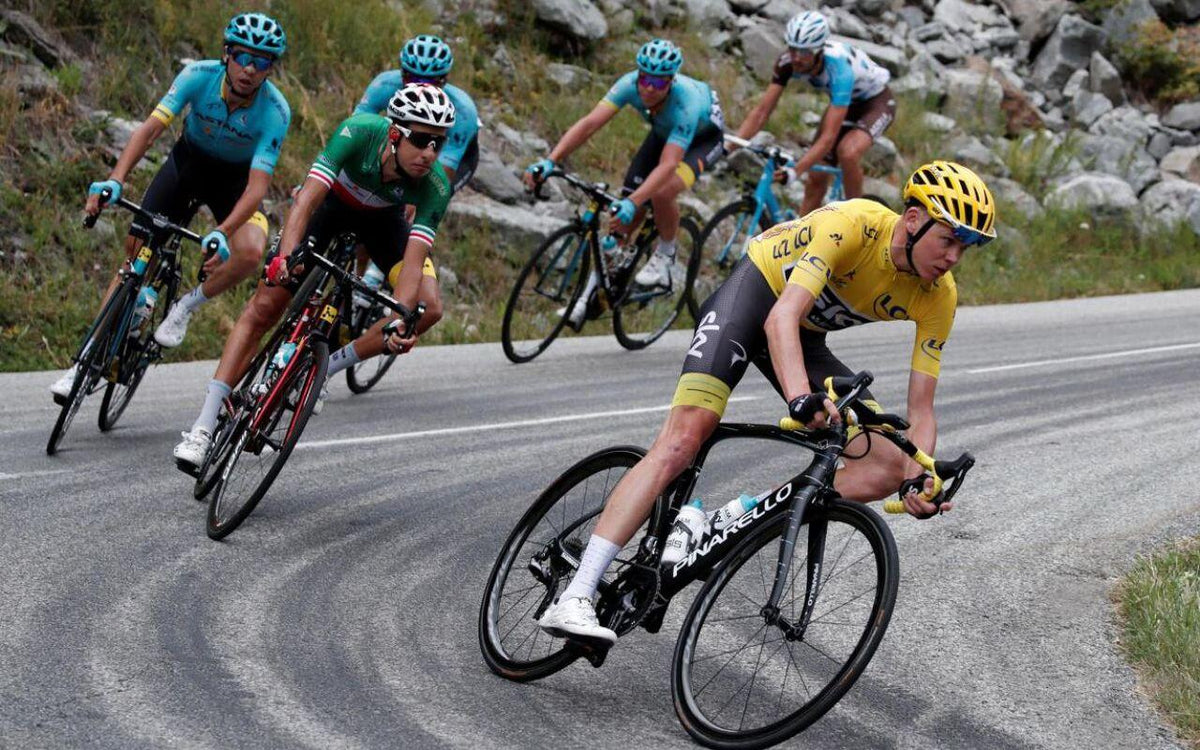
In the mountains, the descent often covers as many kilometers as the ascent and can prove just as grueling if handled poorly. Many cyclists suffer through it rather than pilot their bikes, remaining seated in the saddle and waiting for it to be over. However, descending well is a skill that must be learned, just like climbing: it is a matter of positioning, braking, and reading the road, all of which become even more critical when conditions deteriorate.
An active attitude rather than a passive one
Staying in motion on the bike
Letting yourself glide passively down a descent, coasting with your body relaxed, might seem restful. The opposite is actually true: your reaction time increases, your points of contact shift with every pothole or pebble, and your upper body absorbs unnecessary shocks. Staying active—by pedaling in a suitable gear or maintaining a tuck position—allows you to keep control and arrive at the bottom fresher for the rest of your ride.
Proper body positioning
On a straightaway, an aerodynamic position helps you gain speed without extra effort: cranks horizontal, buttocks slightly off the saddle, knees pressed against the frame, back flattened, and hands in the drops. This position also absorbs road irregularities, unlike a passive seated position, which transmits every shock directly to your back and shoulders.
Braking: modulating rather than suffering
Distributing effort between both brakes
The rear brake regulates speed, while the front brake does the bulk of the slowing down. Using both together, modulating pressure to avoid locking a wheel, remains the golden rule. When increasing pressure on the front brake, you must shift your center of gravity backward so that both wheels maintain contact with the road; without this rebalancing, the risk of going over the handlebars increases significantly.
Brake before the curve, release in the turn
Proper braking happens before entering a curve, while both wheels are still aligned. A hundred meters or so before the turn, sit up and brake firmly to reach your desired speed, then release gradually as you enter the curve. Continuing to brake hard once the bike is leaned into the turn is one of the most frequent causes of crashing; the remaining grip margin does not forgive sudden braking at that precise moment.
Avoiding brake overheating
On a long mountain descent, continuous braking wears down braking surfaces and can reduce their effectiveness at the worst possible moment. Releasing the brakes between turns, rather than keeping them clamped for the entire descent, gives rims or discs time to cool down. This vigilance applies to all braking systems, whether rim or disc.
Perfecting your lines
Widening curves for better stability
Cutting the shortest path through the middle of a turn, while already looking toward the exit, allows you to maintain a rounded trajectory rather than making sharp angles—which are more stable and predictable at high speeds. On open roads, this line is obviously constrained by the width of the lane and the possible presence of other users, but the principle holds: the wider the arc, the less force is abruptly placed on the tires' grip.
Look far ahead, not at your front wheel
Looking far ahead toward the exit of a turn helps you anticipate lines and gives you time to react to an obstacle. Conversely, staring at the road just in front of your wheel narrows your field of vision and delays any necessary adjustments—a reflex that should be prioritized for correction among cyclists who approach descents with apprehension.
Tension is the primary factor in crashing
Stiff riding—hands gripping the levers tightly, shoulders hunched, brakes held as a precaution—fatigues you faster than relaxed riding and provides no extra safety. Confidence on a descent is built gradually: start with known, well-laid-out roads before tackling more technical sequences. A well-negotiated turn is never about raw speed, but rather about a clean line and anticipated braking.
Descending in a group without putting yourself at risk
When riding in a group, the temptation to follow the wheel in front without anticipating your own line is real—and dangerous. Everyone must maintain their own braking margin and their own reading of the road, rather than blindly relying on the pace set by another cyclist. A quick glance behind you before widening your line at the exit of a turn also avoids unpleasant surprises with a vehicle or another rider attempting to pass at the same time.
Descending in the rain
Adapting your speed and handling
Rain reduces grip and increases braking distances, especially with rim brakes, which need a wheel rotation or two to clear away water before biting effectively. Riding more smoothly in these conditions means leaning the bike less, avoiding sudden braking, and widening your lines even more in turns to compensate for the loss of grip.
Identifying high-risk zones
Certain parts of the road deserve extra vigilance in rainy weather: sections under tree cover or near a watercourse remain damp longer than the rest of the route, and a dry section followed by a wet one changes grip in an instant. Cautious riding, with a constant safety margin, more than compensates for any time lost on raw speed.
Cold in the mountains: an underestimated risk
Anticipating the temperature drop
At altitude, the temperature drops by an average of one degree every hundred meters. Fifteen degrees in the valley can thus become five degrees a thousand meters higher—a gap amplified by the wind chill of the descent. A simple windbreaker tucked into a jersey pocket before the climb, or lightweight arm warmers for cooler rides, can radically change your comfort—and therefore your mental clarity on the descent that follows.
Tunnels: a trap for the eyes
Numerous tunnels line mountain roads, often poorly lit. The contrast with daylight can disorient you for a few seconds—enough time to lose your line at high speed. Closing one eye just before entering a tunnel and opening it once inside helps your eyes adapt more quickly to the darkness—a simple reflex that avoids many close calls.
In summary
A well-negotiated descent relies on the same fundamentals as a well-managed climb: an active position, controlled movements, and attentive reading of current conditions. Raw speed matters less than consistency and maintaining a safety margin from one turn to the next. And in bad weather or at altitude, anticipation is always better than suffering.
→ Kadenz also equips you for descents, all the way to the end of the pass. → [Discover the collection]