
Unreliable weather, pollution spikes, or a schedule too tight for a proper ride: the smart trainer remains the easiest solution for not skipping a workout. Used properly, it is a highly effective training tool. Used poorly—with incorrect settings, workouts that are too long, or an underestimation of the heat—it quickly loses all its appeal. Here is how to get the most out of it.
A complement, not a substitute
A smart trainer can effectively help develop certain fitness qualities, but it is not intended to replace hours in the saddle on the road. Cycling remains an endurance sport, and it would be delusional to expect to prepare for a long event solely with short indoor workouts. To track your progress, use the same power measurement source whenever possible. Your bike's sensor and the smart trainer's may display different values. By using the same sensor on the road and indoors, you maintain a consistent reference. However, this does not mean you will be able to sustain exactly the same power in both situations.
Where a smart trainer excels, however, is in everything the road does not easily allow: an intensity workout without having to deal with traffic, training despite a heatwave or pollution episode, or simply the certainty of being able to train regardless of the day's schedule. Used for what it does best rather than as a complete substitute for riding outdoors, it becomes a real asset rather than a last resort.
Choosing the right smart trainer
Pedaling that feels like riding outdoors
A good smart trainer should provide smooth, jerk-free pedaling and accurately simulate the inertia felt on the road. A simple, precise resistance adjustment system also makes a difference in use. A high price does not always mean a better experience: it is better to compare actual features—smoothness, resistance precision, and compatibility with your bike—than to rely solely on the displayed price.
Be aware of the displayed power data
The power figures provided by a smart trainer without a dedicated sensor remain estimates based on the gear ratio used, the resistance level, and the pedaling cadence. In the vast majority of cases, these values are overestimated, especially with large gear ratios at low cadences. However, these figures remain comparable from one workout to the next on the same device, which is enough to track your own progress, even without an external sensor.
Virtual platforms and smart bikes
Virtual training apps have largely popularized smart trainers in recent years, with simulated routes that fairly faithfully reproduce the sensations of riding outdoors. Complete indoor bikes, which are becoming increasingly common, are part of this evolution. To get real benefit from them, it remains essential to set their position identically to that of your regular bike: stem, seat height, and fore-and-aft position, lest you create postural imbalances by repeatedly working out in a position different from the one you use outdoors.
Building quality workouts
Focus on quality rather than duration
Without the natural variations of a route—wind, hills, intersections—a smart trainer cannot guarantee the same diversity of stimulus as an outdoor ride. This is precisely what makes it a valuable tool for precise, measured work: the shorter and more intense the workout, the more the benefits of a smart trainer are confirmed, compared to riding outdoors, where external parameters can never be completely controlled.
Increasing your heart rate without hills
Without wind or hills to vary the intensity, some cyclists struggle to raise their heart rate on a smart trainer. To achieve this, you must develop power that truly corresponds to your own threshold or FTP, rather than settling for a comfortable cadence. At the same heart rate, the effort can also feel harder indoors than outdoors due to the lack of cooling from the wind—a point to keep in mind so as not to rely solely on how you feel.
Testing your FTP on a smart trainer
The absence of wind and elevation changes is precisely what makes a smart trainer an ideal setting for a reliable FTP test: the heart rate varies only according to the prescribed effort and recovery intervals, without external interference. A simple protocol consists of gradually increasing the intensity in regular intervals until you can no longer maintain the pace: the power reached at the last complete interval gives a solid estimate of your FTP, and the heart rate recorded at that moment corresponds to your maximum heart rate.
Managing heat and hydration
Heat that is largely underestimated
Without the natural cooling produced by moving through the air, a smart trainer workout in a closed room feels, in terms of thermal sensation, like a ride done around 30 degrees even in the middle of winter. A powerful fan directed straight at the body becomes almost essential beyond thirty minutes of effort, as does a properly ventilated room. A basement or a room without air circulation should still be avoided, regardless of the motivation to train there in peace.
Dress lightly, even in winter
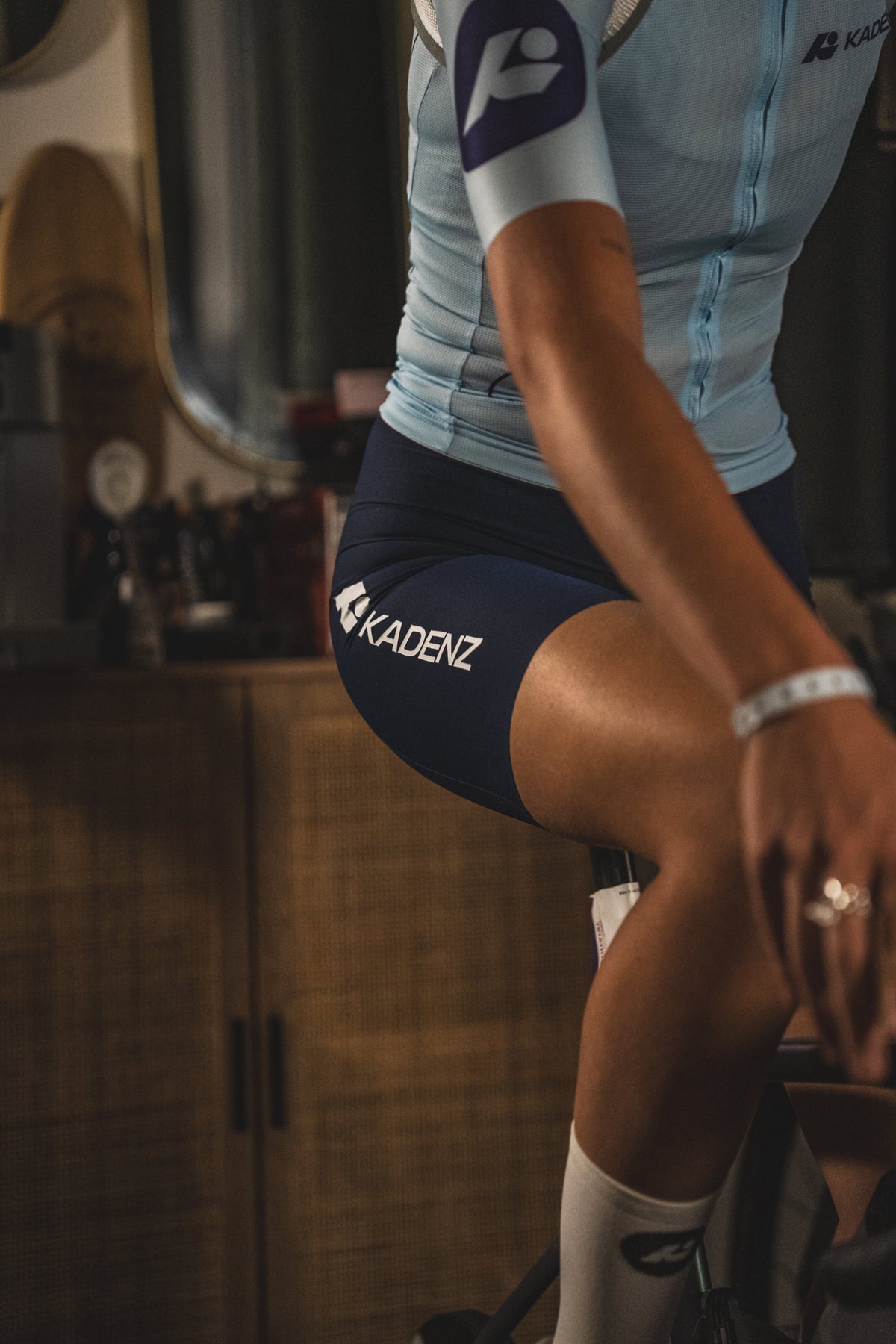
The ideal outfit for a smart trainer workout remains the same all year round: short sleeves and short cycling shorts, regardless of the outdoor temperature. As the minutes pass, the complete lack of airflow quickly raises your body temperature, no matter how cold it is outside. You must also hydrate abundantly during the workout—the equivalent of half a liter every thirty minutes remains a reasonable benchmark for an intense workout.
Organizing your workouts during the week
A smart trainer is well suited to splitting up training over the same day when outdoor conditions prevent any prolonged ride: a short, flexible workout in the morning to wake up your legs, then a more targeted workout at the end of the day. Spacing the two by at least five hours and hydrating throughout the day allows you to accumulate a decent volume without sacrificing the quality of the most demanding workout. Finally, it is better to turn off the television or any other distraction during technical workouts: concentration remains necessary to optimize a movement or cadence, while music can easily accompany the effort without impairing the quality of the work.
In summary
A smart trainer is neither a gadget nor a constraint to endure while waiting for the weather to improve: properly set up, used for short, targeted workouts, and combined with serious heat management, it is a full-fledged training tool. The real risk is not doing too much, but underutilizing it by stringing together workouts that are too long, too easy, and poorly hydrated—the exact opposite of what makes it valuable.
→ Kadenz also dresses indoor workouts, from the smart trainer to the road. → [Discover the collection]