
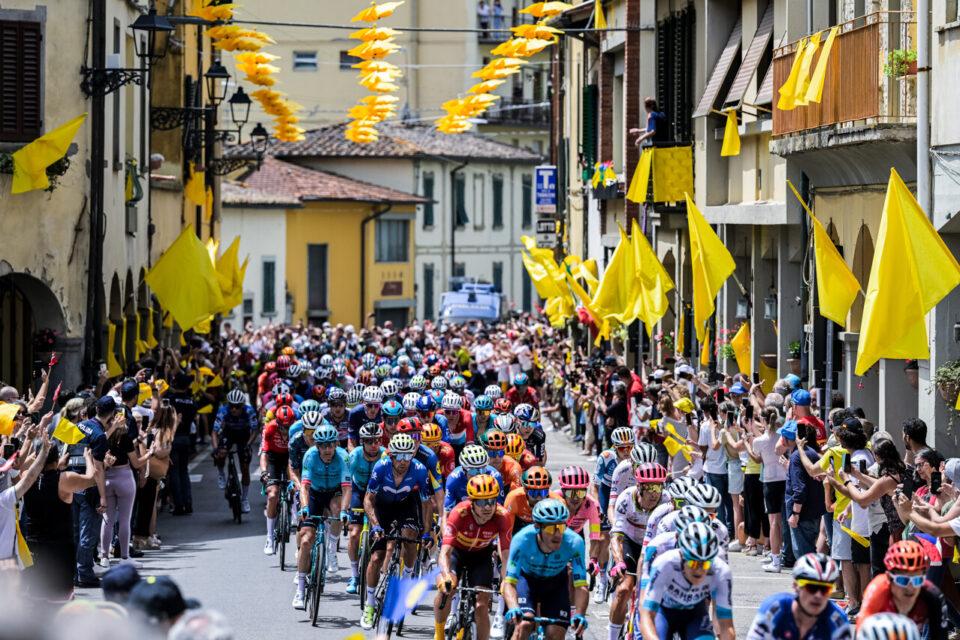
Riding alone and riding in a group do not have much in common. On flat ground, drafting changes everything: tucking into another cyclist's wheel saves up to 30% of energy. But at 40 km/h, this proximity cannot be improvised. Group riding must be practiced, like any other technique; here are the basics to enjoy it without the risks.
Progressive learning
Proximity with other cyclists at high speeds does not come naturally: it is learned, in stages. Starting in small groups on wide, quiet roads allows you to build confidence before venturing into larger pelotons or more demanding routes. Observing experienced cyclists—their positioning, how they take turns at the front, how they handle the wind—remains one of the best ways to progress quickly, far more effective than just trying to match their pace without understanding the logic behind it.
Finding your place in the group
The basic rule can be summed up in a simple instruction: never overlap your front wheel with the rear wheel of the bike in front of you, even in crosswinds. An interval of about twenty centimeters is the standard, a bit more for less experienced cyclists. Too far from the bike in front, the drafting benefit is lost; too close, the slightest change in speed becomes dangerous.
The stability of your gaze matters as much as the distance. Staring at the rear wheel of the bike in front amplifies every reaction to micro-adjustments in speed, whereas looking a bit further ahead, at the group as a whole, allows you to anticipate rhythm changes before they become jolts. This is a reflex built over the miles, not an innate talent.
Communicating for everyone's safety
A group that rides well is a group that stays informed. An arm raised to signal a slowdown, a finger pointed at a pothole or debris on the road, a word shouted to warn of a flat tire or a ringing phone: these simple gestures, repeated from one cyclist to another, prevent most group crashes. Vigilance also applies to other road users, just as it does in car traffic.
This communication doesn't end with immediate safety. Warning of a change in trajectory before starting it, announcing a planned stop for refueling, or simply indicating that you are going to ease off for a few minutes—all this information prevents misunderstandings and last-second reactions, which are often the source of group pile-ups.
Taking your turn at the front without struggle
Leading a group requires maintaining a steady pace, without surges, and never stopping abruptly when giving up your spot. A simple flick of the elbow, on the side you want the next cyclist to pass on, is enough to announce your intention before pulling off smoothly. Another useful tip: do not accelerate significantly faster than the group's pace when you take your turn at the front, as this will disrupt those behind you—a speedometer, even a basic one, helps keep this reference in mind.
Facing the wind: the echelon logic
A headwind is managed well in a compact group. Crosswinds change everything: riding directly behind a single cyclist is no longer useful, and the formation must widen diagonally—this is what is called an echelon. On a two-lane road, a double-file formation allows for efficient rotation: one line moves forward while the other drops back, with everyone shielded from the wind thanks to the diagonal position of the group. This organization requires practice but remains much more effective than a simple, classic alignment in a crosswind.
On roads open to traffic, however, the echelon is constrained by the available road width: it is impossible to occupy the entire lane diagonally without putting the group in danger from vehicles. In this case, it is better to choose a route that limits sections exposed to crosswinds rather than forcing a formation that lacks the space to deploy correctly.
Managing slowdowns without being caught out
A sudden touch of the brakes at the front of the group ripples back, amplified, to the very last rider—this is one of the leading causes of peloton crashes. Slowing down gradually, by sitting up rather than braking hard, gives everyone time to adjust. When approaching an intersection, a roundabout, or a village, it is better to anticipate by moving toward the front of the group rather than staying at the back, where speed changes are always felt with a delay.
Adopting the right group strategy
A group remains efficient against the wind or over long distances if it maintains a certain homogeneity. The strongest cyclists can take longer turns at the front while the others remain sheltered, provided they do not raise the pace to the point of putting the rest of the group in difficulty. The goal is not to demonstrate individual strength, but to move the whole group at a pace everyone can hold—an adjustment that requires as much listening as it does leg power.
Mistakes that undermine group trust
Three behaviors appear most often among less experienced cyclists. Firstly, staying hidden in the draft at all times without ever taking a turn at the front—an attitude that quickly wears out the patience of the rest of the group. Secondly, accelerating too hard when taking the lead, which breaks the group's rhythm instead of maintaining it. And finally, braking hard rather than anticipating a slowdown—the most dangerous reflex of all in a tight peloton. Correcting these three points is enough to transform how a group perceives you—and how they ride with you.
Final thoughts
Group riding remains one of the great pleasures of road cycling: the shared effort, the speed gained without extra effort, the miles that fly by faster in good company. But this pleasure depends directly on each person's discipline—positioning, communication, and managing your turns. The basics are acquired quickly; it is their repetition, ride after ride, that builds the confidence and fluidity of a group that truly rides well together.
→ Kadenz gears you up for group rides just as well as for solo ones. → [Discover the collection]