
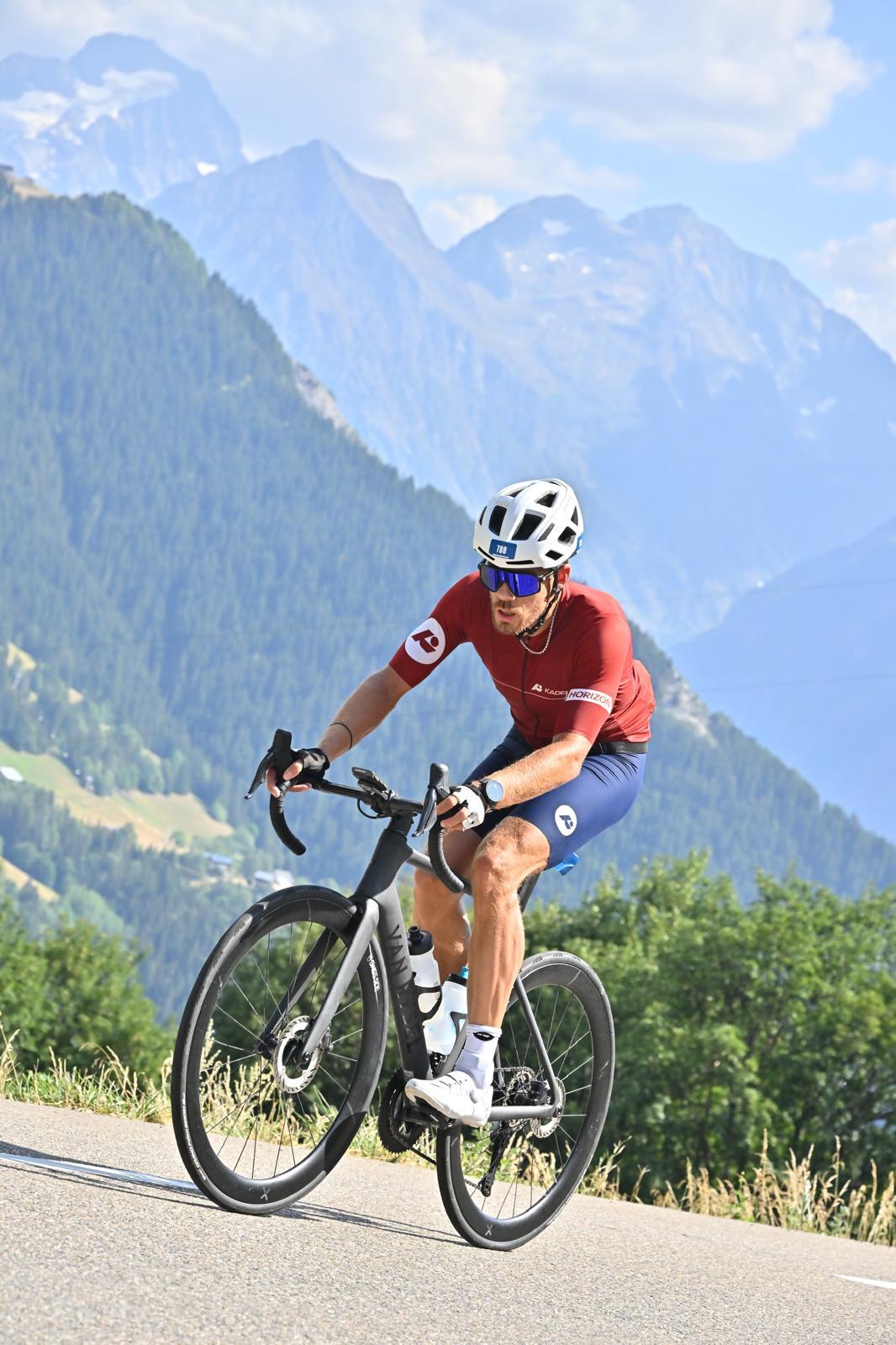
Climbing a mountain pass is about more than just pushing harder on the pedals. Riding position, gear choice, cadence, and long-term pacing: every parameter counts, and their combination makes all the difference between a controlled ascent and a ride that turns into an ordeal in the final kilometers. Here are the technical, equipment, and physiological benchmarks for better climbing.
Adopt the right position for climbing
Adjust your saddle before tackling steep gradients
A saddle adjusted for flat terrain is not necessarily optimal for hills. On an 8% slope, the natural tilt of the pelvis changes and can accentuate a backward shift of the saddle. A slight forward nudge and a tilt of a few degrees downward are often enough to correct your posture without disrupting the rest of the cockpit setup. It is not about rebuilding everything, but about making a fine adjustment to maintain efficient power transmission.
Alternate between sitting and standing
Neither position is superior in absolute terms; they serve different needs. The seated position promotes a steady pace and saves your body over the long haul: this should be your go-to on a long pass. Standing relieves the quadriceps by engaging the posterior chain more and allows you to develop a peak of power over a short time, useful for accelerating or getting over a steep section. Alternating between the two also limits cramping by varying the muscle groups used.
Vary your hand position on the handlebars
Placing your hands on top of the bars opens up the ribcage and makes breathing easier on long stretches at a steady pace. When standing or accelerating, holding the hoods or the drops gives you more leverage to rock the bike from side to side. This often-neglected detail directly influences the efficiency of your movement and the comfort felt during an ascent of several tens of minutes.
Adapt your cadence and pedal stroke
The ideal cadence depends on the slope
On the flat, the reference cadence is around 90 revolutions per minute. Uphill, it drops naturally, but staying above 70 to 80 rpm remains a good benchmark to preserve your muscles over time. Below that, the strain on the muscles takes precedence over the cardiovascular load, which tires you out faster and increases the risk of cramps on long ascents.
Work on your velocity to gain efficiency
The pedal stroke consists of a pushing phase and a pulling phase. The rounder the movement, the less energy is wasted with each turn of the cranks. Working on velocity—pedaling faster with a moderate gear—gradually improves this coordination and ultimately allows you to develop the same power with less muscle fatigue.
Choose the right equipment for the mountains
Gearing: don't be trapped by ego
Climbing with a gear that is too high wears out muscles and raises your heart rate unnecessarily fast. A compact crankset (34 or 36-tooth chainrings) combined with a wide cassette (11-30 or even 11-34) gives you the necessary room to maintain a proper cadence, even on the steepest sections. This choice reflects no weakness; it simply allows you to reach the top of the pass in better physical condition, ready for the rest of the route.
Weight: a factor that counts most on steep slopes
The power-to-weight ratio (expressed in watts per kilogram) becomes decisive as soon as the gradient exceeds 5 to 7%. On a false flat, a heavier but more powerful cyclist compensates without difficulty. Conversely, on a severe mountain pass, every extra kilogram on the bike—as well as on the cyclist—weighs directly on the climbing speed. Losing one or two kilos of body weight usually has more impact than lightening your equipment by the same amount, and it costs significantly less.
Wheels adapted to the task
Tire pressure designed for the road you're riding
Prepare your body before the climbing season
Increase elevation gain, without excess
Dissociate strength work and velocity work
Simulate mountains when living on the plains
Manage effort during the ascent
Don't start too hard on the first climb
Rely on objective benchmarks
Refuel before you feel the need
Recover between multiple climbs
Mental strength counts as much as the legs
In summary
Climbing well does not depend on a single miracle setting, but on the sum of several adjustments: a suitable position, a cadence sustainable over time, gears that preserve your muscles, managed weight, and effort management planned from the very foot of the pass. Taken in isolation, each of these elements seems minor. Combined, they transform a dreaded ascent into a controlled moment and, at the summit, into a true satisfaction.
→ Kadenz equips cyclists who climb, to the summit and beyond. → [Discover the collection]